PD Dr. Mirjam Leuzinger

Photo: Mirjam Leuzinger
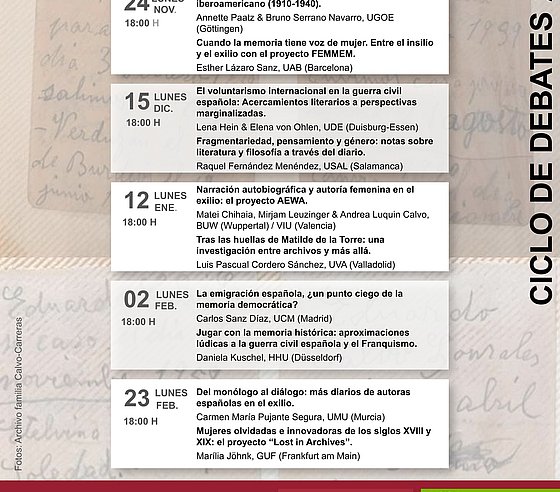
Co-Principal Investigator of the DFG-funded project “Autobiographical Narration and Female Authorship in Spanish Exile after 1936” (AEWA)
Email: leuzinger[at]uni-wuppertal.de
Online profiles: ORCID | Academia.edu | LinkedIn
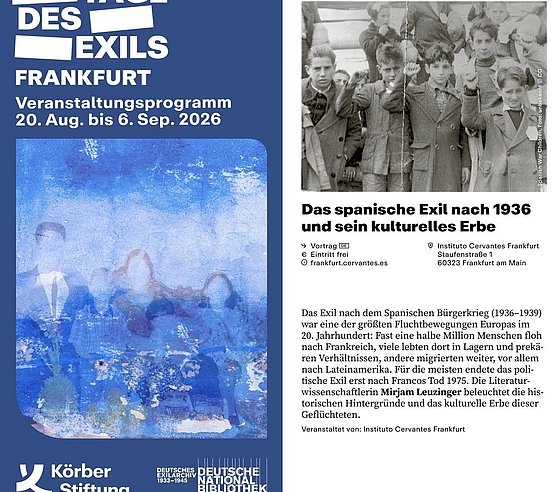
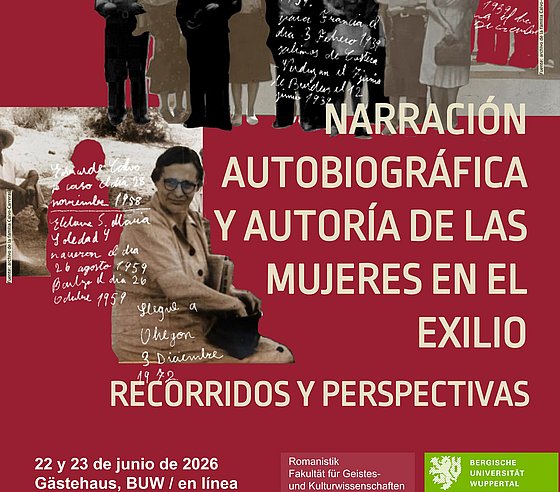
Since 06/2025 DFG-funded individual research position in the research project “Autobiographical Narration and Female Authorship in Spanish Exile after 1936” (Projektnr.: 55885522)
07/2025 Completion of the Habilitation, University of Passau
2023-2025 Lecturer for Special Assignments and Research Associate (interim), Department of Romance Studies, University of Münster
2020-2022 Habilitation scholarship holder within the Bavarian programme for the promotion of equal opportunities for women in research and teaching, University of Passau
2014-2020 Research Associate, Romance Studies, University of Passau
2018 Certificate in Higher Education Teaching, Bavarian Universities
2016 Research stay and visiting lectureship, Universidade Federal do Paraná, Brazil
2014-2017 Coordinator of the academic journal Versants: Revue Suisse des littératures romanes
2014 PhD in Hispanic Studies, University of Bern, Switzerland
2012 Scholarship holder of the Swiss National Science Foundation
- Research stay, Universidad Complutense de Madrid, Spain, 1 semester
- Research stay, Franz Kafka Centre, Czech Republic, 2 months
- Research and study stay, Université Paris 8, France, 1 semester
2009-2012 Research and Teaching Assistant, Institute of Spanish Language and Literatures, University of Bern
2010-2014 B.A. and M.A. in French Language and Literature, minor subject, University of Bern
2008-2011 Teaching diploma for upper secondary schools in Spanish and Physical Education, Bern University of Teacher Education
2007-2009 Translator, Spanish German and Spanish French, Traducciones Castilla, Valladolid, Spain
2006-2007 Visiting student, Universidad de Valladolid, Spain
2004-2009 B.A. and M.A. in Spanish Linguistics and Literature, major subject, and Sports Science, minor subject, University of Bern
- Contemporary Literatures and Cultures of Latin America, Spain, and France
- Decolonial Discourses on Europe
- Migration & Exile Studies
- Jorge Semprún (1923-2011)
- Diversity & Disability Studies
- Memory Studies & Disaster Studies
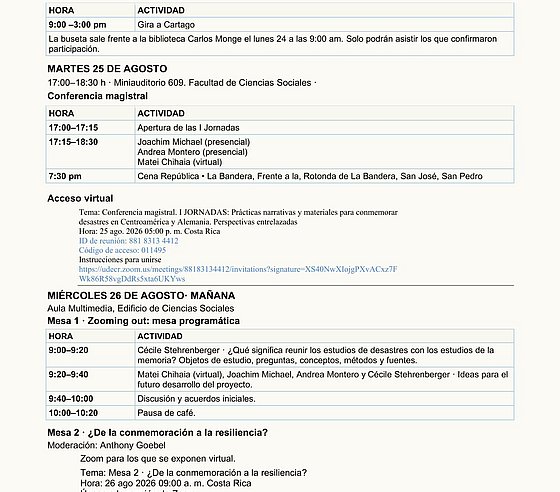
Since 11/2025 Member of the DFG-funded research collaboration „Narrative and Material Practices of Commemorating Disasters in Central America and Germany: Entangled Perspectives", Wuppertal / Bielefeld / Costa Rica
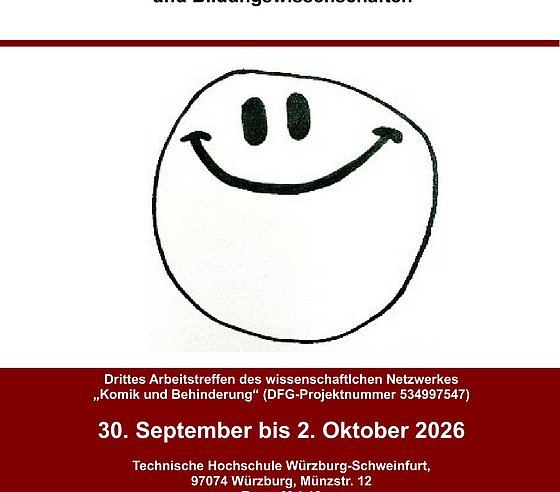
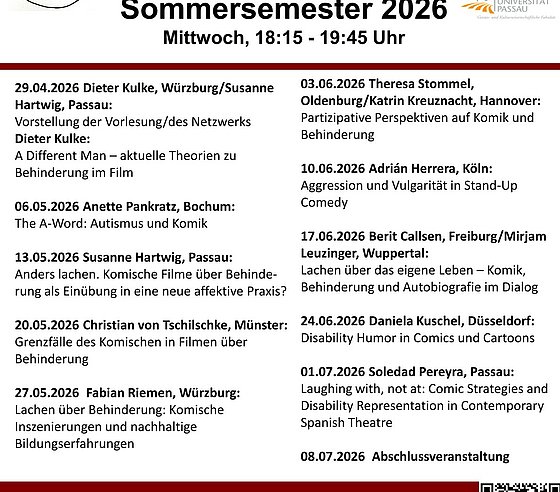
Since 04/2024 Member of the DFG-funded research network „Komik und Behinderung im Schnittpunkt von Kultur-, Medien-, Sozial- und Bildungswissenschaften“, Passau
Since 05/2021 Member of the international network „FENIX: Network for Research on Female Exiles and Refugees“, Utrecht
2020-2024 Member of the DFG-funded research network „The Literary and Philosophical Legacy of the Spanish Exile in Mexico“ (LEXEM), Wuppertal
Autobiopgraphical Narration and Female Authorship in Spanish Exile after 1936
Duration: 2025-2028 (ongoing)
Funding: German Research Foundation (DFG), Research Grant (eigene Stelle)
Keywords: Spanish Exile Literature, Spanish Exile in Mexico, Autobiography, Female Authorship
_______________________________________________
Habilitation project
Repensar Europa: Una mirada transatlántica al discurso intelectual en América Latina y Francia (1945-1992)
Duration: 2015-2024 (completed)
Funding: Free State of Bavaria, Postdoctoral Fellowship for the Promotion of Gender Equality in Research and Teaching at the University of Passau (April 2020; June 2021–October 2022)
Keywords: Decolonial Europe; Latin American Studies; French Studies; Essays; Intellectual History
Description: This postdoctoral research project (habilitation) undertakes a critical examination of discourses on Europe articulated by intellectuals in Latin America and France between 1945 and 1992. Against the backdrop of post-war reconstruction, the Cold War, decolonization, and the nascent project of European unification, the study explores how “Europe” was imagined, contested, and reconfigured in essayistic texts beyond its traditional centers of self-definition.
It proceeds from the assumption that Europe is not a fixed geographical or political entity, but a historically contingent and discursively constructed concept. The project analyzes more than 90 primary texts by 31 intellectuals from both sides of the Atlantic—among them Germán Arciniegas, Darcy Ribeiro, Roberto Fernández Retamar, Frantz Fanon, Albert Camus, Jean-Paul Sartre, and Raymond Aron—who reflect from divergent yet intersecting perspectives on Europe’s values, internal contradictions, and global significance.
Methodologically, the study draws on postcolonial and decolonial theory, intellectual history, and comparative literature. It foregrounds the heuristic potential of transatlantic perspectives—not as reflections of a unified or idealized Europe, but as productive frictions that destabilize dominant narratives. At its core lies the notion of a “responsible memory”: a mode of historical reflection that acknowledges the continent’s complicity in violence and exclusion, while opening up space for plural and decentered reimaginings.
By rethinking Europe through these heterogeneous voices, the project contributes to a more nuanced understanding of postwar intellectual history and intervenes in current debates on identity, memory, and the critical role of the humanities in a globalized world.
_______________________________________________
Doctoral project
Jorge Semprún: Memoria cultural y escritura. Vida virtual y texto vital
Duration: 2009-2014 (completed)
Funding: Swiss National Science Foundation (SNSF), Fellowship for Prospective Researchers (March–December 2012)
Keywords: Jorge Semprún; Spanish Literature; Cultural Memory; Intertextuality; Intermediality; Metatextuality
Description: With Jorge Semprún’s death on 7th June 2011, Europe lost not only one of its most important intellectuals, a witness of the Buchenwald concentration camp, a politician and a recognized author and screenwriter, but also a “memory of the twentieth century”. Embedded in the context of the two European totalitarianisms of the 20th century - Stalinism and Nazism - both his life and work are unique and exemplary for the major European concerns of that period.
Memory within testimonial, autobiographical and autofictional conception has been a primary and important area of research as far as the author’s work is concerned: However when considering the studies on “cultural memory”, that is to say, on an ‘uninhabited’ and on normative texts based remembering, Jorge Semprún’s literary creation expands the boundaries of autobiographical or testimonial memory, collective or fictive memory, to include an equally significant distant memory, transmitted thanks to the author’s unique literary culture. Cultural memory leaves obvious traces, not only by means of literary, political and philosophical influences, but also thanks to a both implicit and explicit contemplation of the act of forgetting and remembering within a cultural perception of archive and generation. On the basis of nine major literary and pictorial influences, the project focuses on the intersection between memory, “intertextuality”, “intermediality” and “metatextuality” that constitutes the rich cultural tissue of Jorge Semprún’s work: a Cervantine “literatura desatada” that is both unlimited and coherent in its generic and discursive transgressions. By looking at the influence on the author of Fyodor Dostoyevsky’s The Demons, Paul Nizan’s La conspiration, Federico García Lorca’s The House of Bernarda Alba, William Faulkner’s Absalom, Absalom!, Eugène Sue’s Les Mystères de Paris, Franz Kafka’s letters to Milena Jesenská and Felice Bauer and the selected paintings by Artemisia Gentileschi, Joachim Patinir and Johannes Vermeer, the research will reveal a dynamic mnemonic universe barely considered to date, but that arguably forms the very basis of the author’s writing. The phenomena “literatura desatada” and cultural memory thus present in Jorge Semprún’s work a textual life enriched by the multiple (auto-) referential games which deliver to the reader a vital text not only in an autobiographical, but also in an aesthetic sense of a constantly recreated, reinvented and reinterpreted artistic creation.
Monographs
Repensar Europa: Una mirada transatlántica al discurso intelectual en América Latina y Francia (1945-1992). [manuscript under revision]
Leuzinger, Mirjam. Jorge Semprún: Memoria cultural y escritura. Vida virtual y texto vital. Madrid: Verbum, 2016.
Reviews:
Beatriz Coca Méndez, Laberintos. Revista de estudios sobre los exilios culturales españoles 18, 2016, 657-659.
Marina Gauthier-Dubédat, Iberoamericana 18.69, 2018, 257-272.
Javier Luis Velloso Álvarez, Anales de la Literatura Española Contemporánea 44.2, 2019, 231-237.
Edited Volumes
Gallo González, Danae/Leuzinger, Mirjam/Dolle, Verena (eds.). Hispanos en el mundo: Emociones y desplazamientos históricos, viajes y migraciones. Berlin: De Gruyter, 2021. DOI: https://doi.org/10.1515/9783110727555.
Review:
Ineke Phaf-Rheinberger, Iberoamericana 22.81, 2022, 282-286.
Leuzinger, Mirjam (ed.). Jorge Semprún. Frontières | Fronteras. Tübingen: Narr Francke Attempto, 2018.
Reviews:
Scheherezade Pinilla Cañadas, Laberintos. Revista de estudios sobre los exilios culturales españoles 20, 2018, 435-437.
Gloria María Prado Garduño, Nueva Revista de Filología Hispánica LXVII.2, 2019, 712-719.
Bärtschi, David F./Leuzinger, Mirjam (eds.). Vidas y caídas. Calas interdisciplinarias en el motivo del fracaso. Berlin: Tranvía, 2011.
Reviews:
Rudolf Kerscher, Hispanorama 138, 2012, 121-122.
José Manuel Camacho Delgado, Iberoamericana 50, 2012, 226-228.
Chapters in Introductory Volumes and Handbooks
Leuzinger, Mirjam. „Mestizaje, Transkulturation und Hybridität“. In: Hartwig, Susanne. Einführung in die Literatur- und Kulturwissenschaft Lateinamerikas. Stuttgart/Weimar: J. B. Metzler, 2018, 326-335.
Leuzinger, Mirjam. „Lateinamerika und Europa“. In: Hartwig, Susanne. Einführung in die Literatur- und Kulturwissenschaft Lateinamerikas. Stuttgart/Weimar: J. B. Metzler, 2018, 296-309.
Articles and Book Chapters
Leuzinger, Mirjam. „La Guerra Civil en clave femenina y la hibridación del relato autobiográfico: Carlota O’Neill, María Teresa León y Otília Castellví“. In: Candeloro, Antonio/Pujante Segura, María Carmen/Pronkevich, Oleksandr/Reinstädler, Janett (Hg.): Guerras: hibridación de prácticas estéticas en torno a conflictos armados (siglos XX–XXI). Frankfurt a. M./Madrid: Vervuert/Iberoamericana. [accepted].
Leuzinger, Mirjam/Pastoriza, Malena. „Humor's Ambivalent Power in Latin American Disability Life Writing: Marcelo Rubens Paiva and Matías Fernández Burzaco“. In: Pankratz, Anette (Hg.). Komik, Behinderung und Medien / Comedy, Disability and the Media. Berlin: De Gruyter. [accepted]
Leuzinger, Mirjam. „La maternidad en contextos de migración: Silvia Mistral y el exilio republicano español en México“. In: iMex. México interdisciplinario / Interdisciplinary Mexico 13. 25, 2024, 18-35. DOI: https://doi.org/10.23692/iMex.25.2.
Leuzinger, Mirjam. „Max Aub y Jorge Semprún: el exilio europeo y la Europa del exilio puestos en escena“. In: Anales de la Literatura Española Contemporánea 49.2, 2024, 45-72.
Leuzinger, Mirjam. „Sobre (sillas de) ruedas en Brasil: Cuerpos diversos y discapacidad física en el documental y el cine de ficción“. In: Callsen, Berit/Seidel, Philipp (eds.). Cuerpos diversos: Estéticas de diversidad corporal en España y América Latina en los siglos XX y XXI. Berlin: Tranvía, 2023, 71-86.
Leuzinger, Mirjam. „Carlos Ruiz Zafón: La sombra del viento (2001)“. In: Schmelzer, Dagmar/Junkerjürgen, Ralf/Mecke, Jochen/Pöppel, Hubert (eds.). Wegmarken der spanischen Literatur des 21. Jahrhunderts. Berlin: Erich Schmidt Verlag, 2022, 25-33.
Leuzinger, Mirjam. „Emociones ante un continente en ruinas: La Europa posbélica de Manuel Mujica Lainez en la crónica de viajes latinoamericana“. In: Gallo González, Danae/Leuzinger, Mirjam/Dolle, Verena (eds.). Hispanos en el mundo: Emociones y desplazamientos históricos, viajes y migraciones. Berlin: De Gruyter, 2021, 99-118. DOI: https://doi.org/10.1515/9783110727555-006.
Gallo González, Danae/Leuzinger, Mirjam/Dolle, Verena. „Introducción: emociones y desplazamientos históricos, viajes y migraciones en el mundo hispano en el punto de mira: Aproximaciones interdisciplinarias“. In: Gallo González, Danae/Leuzinger, Mirjam/Dolle, Verena (eds.). Hispanos en el mundo: Emociones y desplazamientos históricos, viajes y migraciones. Berlin: De Gruyter, 2021, 1-14. DOI: https://doi.org/10.1515/9783110727555-001.
Leuzinger, Mirjam. „Adiós a la luz de los veranos: el exilio y la memoria cultural de Jorge Semprún“. In: Ínsula: Revista de Letras y Ciencias Humanas 891, 2021, 6-10.
Leuzinger, Mirjam. „¿Hacia un séptimo arte inclusivo? El cine brasileño a través del prisma de los disability studies“. In: Hartwig, Susanne (ed.). Inclusión, integración, diferenciación. La diversidad funcional en la literatura, el cine y las artes escénicas. Frankfurt a. M. et al.: Peter Lang, 2020, 293-308. DOI: https://doi.org/10.3726/b16655.
Leuzinger, Mirjam. „Ästhetik des (Nicht-)Wissens im Spiegel der Globalisierung: El delirio de Turing (2003) von Edmundo Paz Soldán“. In: Pröll, Julia/Mathis-Moser, Ursula (eds.). Transkulturelle Begegnungsräume? Ästhetische Strategien der Überlagerung, Pluralisierung und Simultaneität in den zeitgenössischen romanischen Literaturen. Würzburg: Königshausen & Neumann, 2020, 109-124.
Leuzinger, Mirjam. „(Des)encuentros transatlánticos y diversidad cultural vistos a través del ensayo y la ficción: los americanos y los europeos de Eduardo Caballero Calderón“. In: Hartwig, Susanne (ed.). Diversidad cultural – ficcional - ¿moral?. Frankfurt a. M./Madrid: Vervuert/Iberoamericana, 2018, 305-320.
Leuzinger, Mirjam. „Jorge Semprún. Frontières | Fronteras: Introducción“. In: Leuzinger, Mirjam (ed.). Jorge Semprún. Frontières | Fronteras. Tübingen: Narr Francke Attempto, 2018, 7-14.
Leuzinger, Mirjam. „Literaturas en diálogo | Literaturas en la frontera: Goethe, Blum y la memoria cultural de Jorge Semprún“. In: Leuzinger, Mirjam (ed.). Jorge Semprún. Frontières | Fronteras. Tübingen: Narr Francke Attempto, 2018, 91-105.
Leuzinger, Mirjam. „Normas vigentes, encubiertas responsabilidades: Consideraciones morales en El acoso y El derecho de asilo, de Alejo Carpentier“. In: Hartwig, Susanne (ed.). Ser y deber ser: dilemas morales y conflictos éticos del siglo XX vistos a través de la ficción. Frankfurt a. M./Madrid: Vervuert/Iberoamericana, 2017, 379-394.
Leuzinger, Mirjam. „El pantano y la intemperie. Metáforas de la crisis en las obras de Rafael Chirbes y Jesús Carrasco“. In: Mecke, Jochen/Junkerjürgen, Ralf/Poeppel, Hubert (eds.). Discursos de la crisis. Respuestas de la cultura española ante nuevos desafíos. Frankfurt a. M./Madrid: Vervuert/Iberoamericana, 2017, 247-264.
Leuzinger, Mirjam. „Jorge Semprun, en quête de l’homme européen“. In: García Bascuñana, Juan F. (ed.). Jorge Semprún. Memoria, historia, literatura. Mémoire, histoire, littérature. Bern: Peter Lang, 2015, 89-102.
Leuzinger, Mirjam. „Realidades imaginadas y academia: Un momento de descanso de Antonio Orejudo“. In: Gil González, Antonio J. (eds.). Las sombras del novelista. AutoRepresentacioneS #3. Dijon: Editions OrbisTertius, 2014, 219-230.
Leuzinger, Mirjam. „De la presse clandestine aux adieux du ‚pseudonyme‘ Federico Sánchez: l’engagement intellectuel et politique dans le discours semprunien“. In: Céspedes, Jaime/Iturralde, Xavier (eds.). Études sur José María de Semprún Gurrea, Jorge Semprún et Carlos Semprún Maura. Nanterre: Université Paris Ouest Nanterre La Défense, 2013, 25-36.
Leuzinger, Mirjam/López, José Manuel. „Jorge Semprún, escritor con vida e historia europeas, figura señera en las controversias político-culturales, ideológicas y literarias de su tiempo“. In: Iberoamericana 45 (Sektion: „Foro de debates“), 2012, 157-162. https://journals.iai.spk-berlin.de/index.php/iberoamericana/article/view/1056/736.
Leuzinger, Mirjam. „La carta cerrada o los secretos de Don Extravagancias“. In: Análisis. Revista de Psicoanálisis y Cultura 24 (special issue on Gustavo Martín Garzo), 2012, 121-126.
Leuzinger, Mirjam. „El yo sempruniano en L’écriture ou la vie“. In: Álvarez, Marta/Gil González, Antonio J./Kunz, Marco (eds.). (Meta)Narrativas Hispánicas. Berlin et al: LIT, 2012, 179-189.
Leuzinger, Mirjam. „‚Personajes de la borrachera del jefe‘: El fracaso humano en Guillermo Tell tiene los ojos tristes“. In: Bärtschi, David F./Leuzinger, Mirjam (eds.). Vidas y caídas. Calas interdisciplinarias en el motivo del fracaso. Berlin: Tranvía, 2011, 111-124.
Bärtschi, David F./Leuzinger, Mirjam. „Una síntesis destinada al fracaso“. In: Bärtschi, David F./Leuzinger, Mirjam (eds.). Vidas y caídas. Calas interdisciplinarias en el motivo del fracaso. Berlin: Tranvía, 2011, 219-227.
Leuzinger, Mirjam. „De criaturas monstruosas: El mitema del hombre pez en la obra de Gustavo Martín Garzo“. In: López Criado, Fidel (ed.). Héroes, mitos y monstruos en la literatura española contemporánea. Santiago de Compostela: Andavira Ediciones, 2009, 179-184.
Review Article
Leuzinger, Mirjam. „Jorge Semprún, figura destacada de la Europa del siglo XX (1) / Jorge Semprún, Leading Figure of Twentieth-Centrury Europe (I)“. In: Iberoamericana 18.68, 2018, 253-263. DOI: https://doi.org/10.18441/ibam.18.2018.68.253-263.
Reviews
Leuzinger, Mirjam. „Aub, Max: Diarios (1939-1972), editado por Manuel Aznar Soler. Sevilla: Renacimiento, 2023“. In: Anales de la Literatura Española Contemporánea 51.2, 2026, 771-773.
Leuzinger, Mirjam. „Bridet, Guillaume/Hertrampf, Marina Ortrud M. (éds.) (2024). L’Europe dans la revue Europe (1923-2023). München: AVM.“. In: PhiN – Philologie im Netz 99, 2025, 92-96. https://web.fu-berlin.de/phin/phin99/p99t8.pdf.
Leuzinger, Mirjam. „Martina Kopf/Sascha Seiler (Hg.): Komparatistische Blicke auf Lateinamerika und Europa. Heidelberg: Winter 2016, 227 S. (Intercultural Studies, 6)“. In: Romanische Forschungen 131.2, 2019, 281-284.
García Bascuñana, Juan F./Landman, Thomas/Leuzinger, Mirjam/Nieto, Felipe/Piquer, Alicia. „El ‚corto‘ viaje de Soledad Fox Maura“. In: Claves de Razón Práctica 263, 2019, 128-135.
Leuzinger, Mirjam. „Aznar Soler, Manuel: El teatro de Jorge Semprún. Zürich et al.: LIT, 2015“. In: Anales de la Literatura Española Contemporánea 43.2, 2018, 230-233.
Leuzinger, Mirjam. „Casas, Ana (ed.): El yo fabulado. Nuevas aproximaciones críticas a la autoficción. Madrid / Frankfurt: Iberoamericana, 2014“. In: Iberoamericana 16.62, 2016, 251-255. https://doi.org/10.18441/ibam.16.2016.62.235-258 .
Leuzinger, Mirjam. „Céspedes, Jaime (ed.): Cinéma et engagement. Jorge Semprún scénariste. Condé-sur-Noire: CinémAction, 2011“. In: Iberoamericana 12.46, 2012, 234-235. https://journals.iai.spk-berlin.de/index.php/iberoamericana/article/view/1219/875.
Leuzinger, Mirjam. „O’Leary, Catherine/Ribeiro de Menezes, Alison: A Companion to Carmen Martín Gaite. Woodbrigde: Tamesis, 2008“. In: Iberoamericana 11.43, 2011, 219-221. journals.iai.spk-berlin.de/index.php/iberoamericana/article/view/1241/893.
Leuzinger, Mirjam. „Hartwig, Susanne/Pörtl, Klaus (ed.): La voz de los dramaturgos: El teatro español y latinoamericano actual. Tübingen: Niemeyer, 2008“. In: Iberoamericana 10.40, 2010, 246-247. https://journals.iai.spk-berlin.de/index.php/iberoamericana/article/view/1268/919.
Leuzinger, Mirjam. „Augstein, Franziska: Von Treue und Verrat: Jorge Semprún und sein Jahrhundert. München: C.H. Beck, 2008 / Vordermark, Ulrike: Das Gedächtnis des Todes: Die Erfahrung des Konzentrationslagers Buchenwald im Werk Jorge Semprúns. Köln, etc.: Böhlau Verlag, 2008“. In: Iberoamericana 10.39, 2010, 299-300. https://journals.iai.spk-berlin.de/index.php/iberoamericana/article/view/1274/925.
Other publications
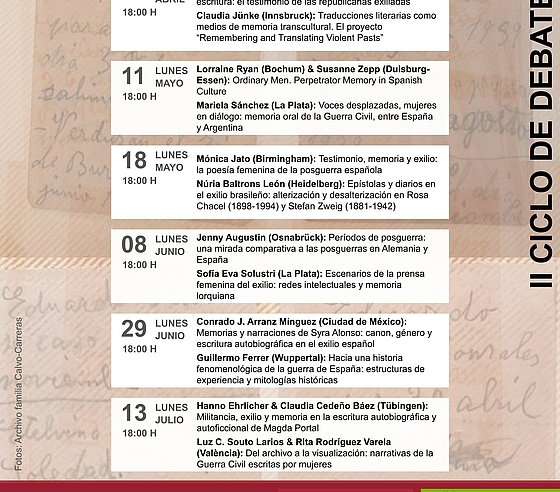
Leuzinger, Mirjam. „Del voluntarismo internacional al diario del exilio: Memoria del segundo encuentro del ciclo de debates 'Memorias en diálogo'“. In: Blog of the AEWA Project, 10/01/2026. Blog.
Leuzinger, Mirjam. „De Madrid a Passau: Entrevista a Julio Checa“. In: Blog „Images of Disability“, 14/09/2022. https://images-of-disability.uni-passau.de/una-charla-con-julio-checa/.
Leuzinger, Mirjam. „Colegas – wenn Kleinkriminelle mit Behinderung zum Kinohit werden“. In: Blog „Images of Disability“, 03/05/2022. https://images-of-disability.uni-passau.de/colegas-wenn-kleinkriminelle-mit-behinderung-zum-kinohit-werden/.
Leuzinger, Mirjam/López, José Manuel. „Nachruf. Nicht wegzudenken: Schriftsteller Semprún“. In: Die Weltwoche 24, 2011, 13.